Technical
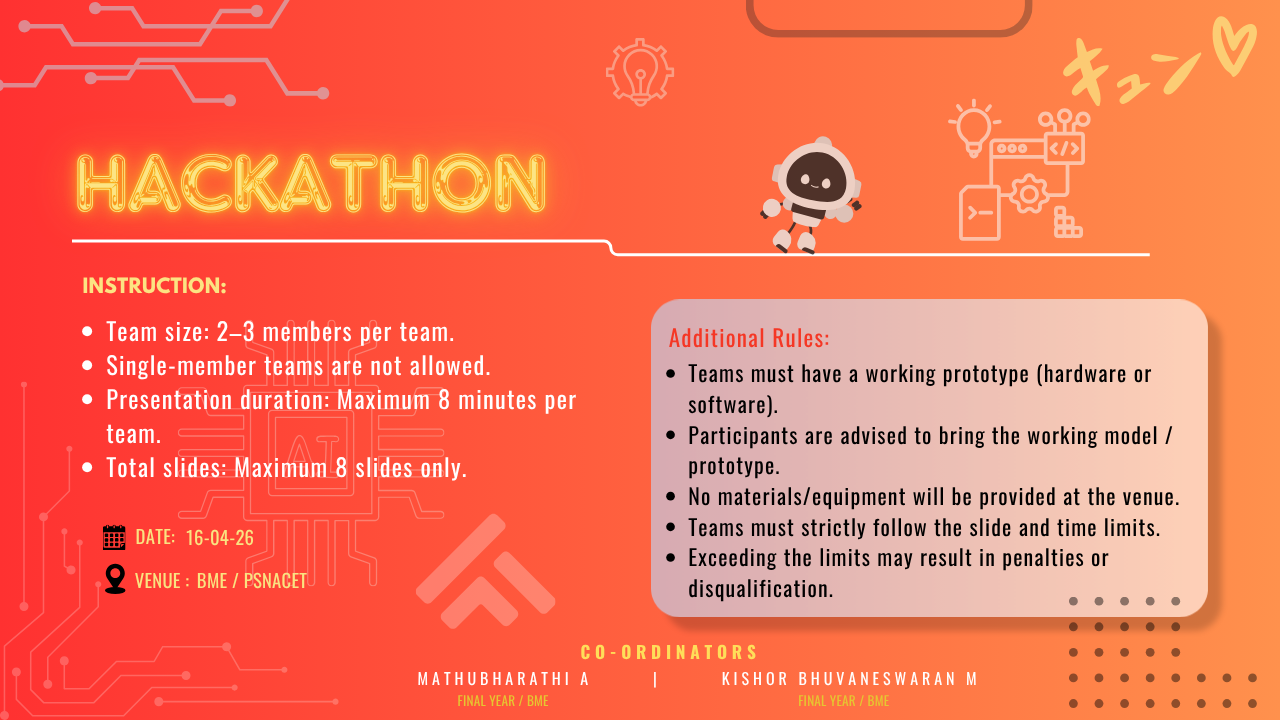
Hackathon
Build, innovate, and present a working prototype — 2–3 members, 8 slides max, 8 minutes.
Department of Biomedical Engineering
2K26
"Technology is best when it brings people together."
"Biogenesis: Engineering the Future of Human Health"
MedXperia 2K26 is a National Level Technical Symposium proudly presented by the Department of Biomedical Engineering at PSNA College of Engineering & Technology (An Autonomous Institution). This flagship event brings together the brightest minds to compete, collaborate, and innovate across both technical and non-technical domains.
From paper presentations and hackathons to creative challenges and gaming tournaments, MedXperia offers a vibrant platform for students of all departments to showcase their talents. Certificates for all participants, and food & accommodation will be provided.
Registration Fee: ₹250/- | Open to: All Departments
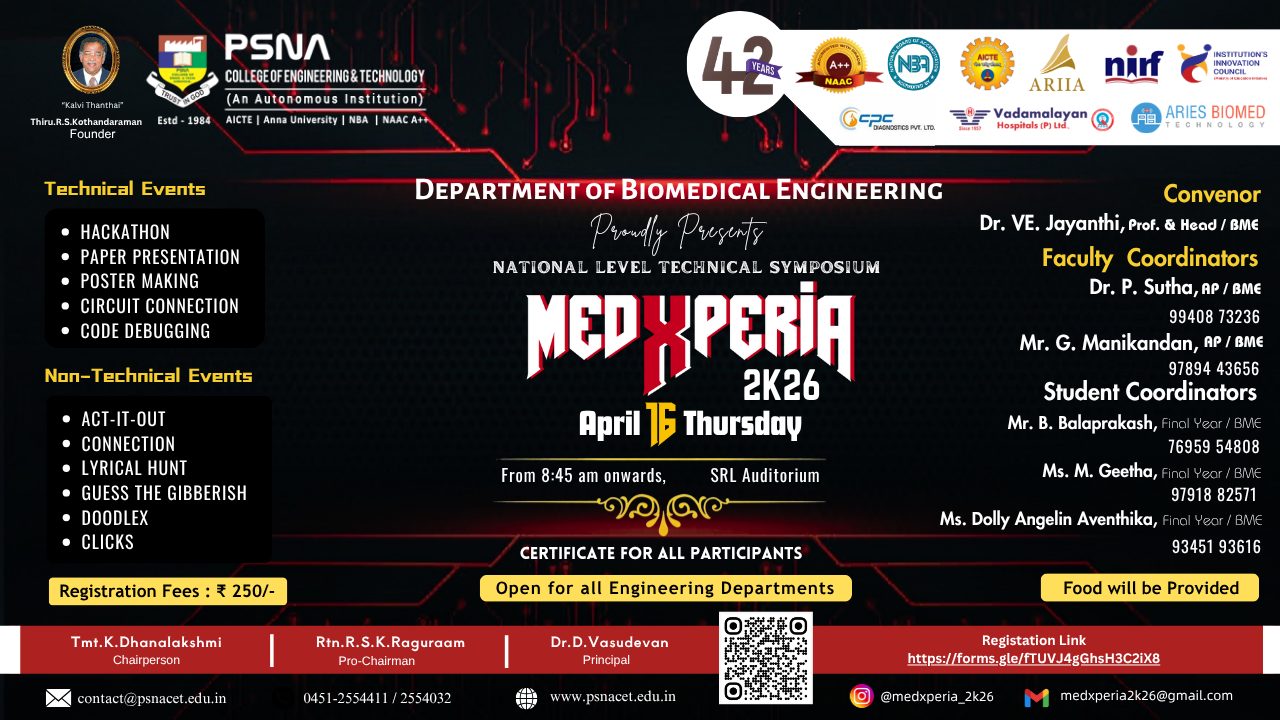
Choose your arena — technical mastery or creative brilliance
Build, innovate, and present a working prototype — 2–3 members, 8 slides max, 8 minutes.
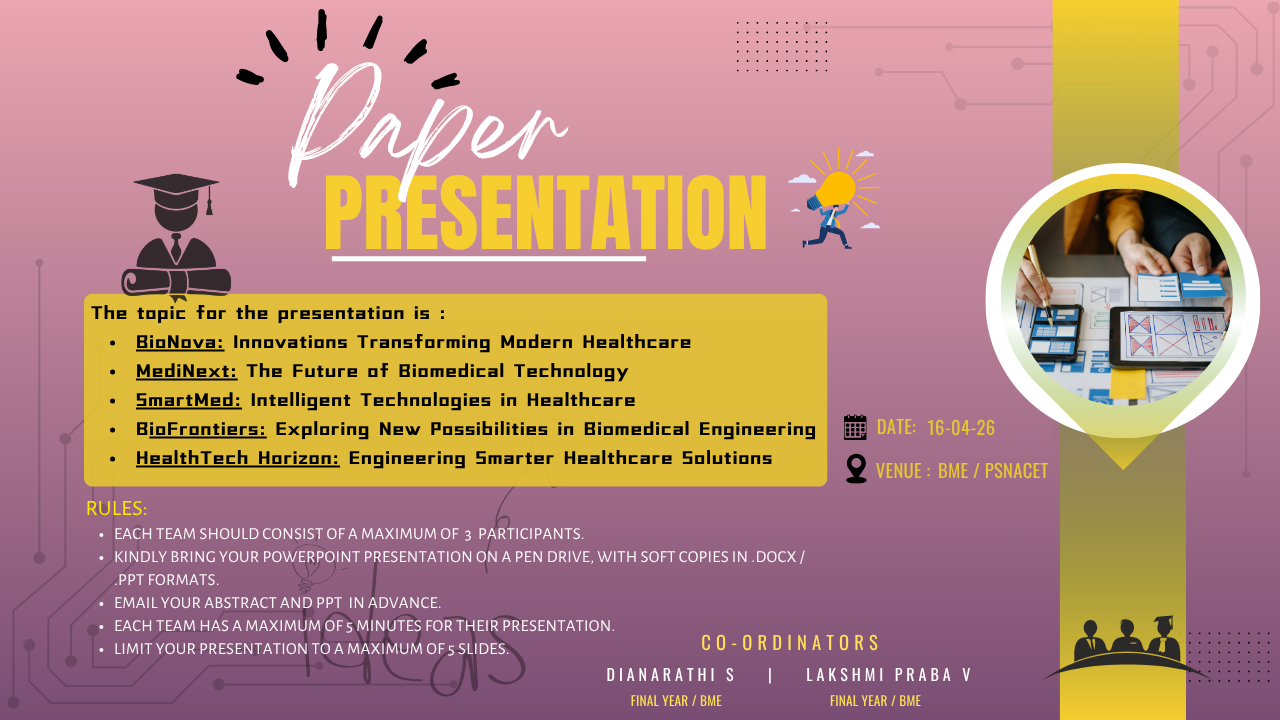
Present innovative ideas in biomedical engineering — BioNova, MediNext, SmartMed & more topics.
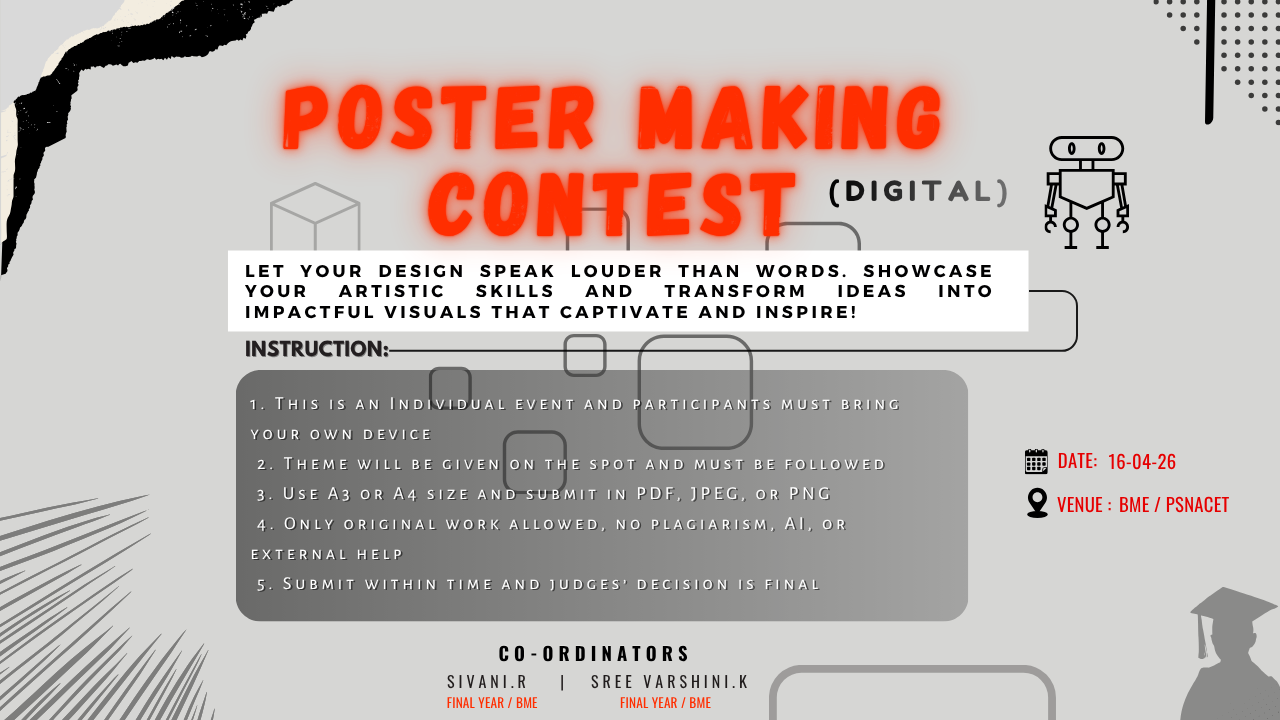
Showcase your artistic skills — individual event, digital design on A3/A4, original work only.
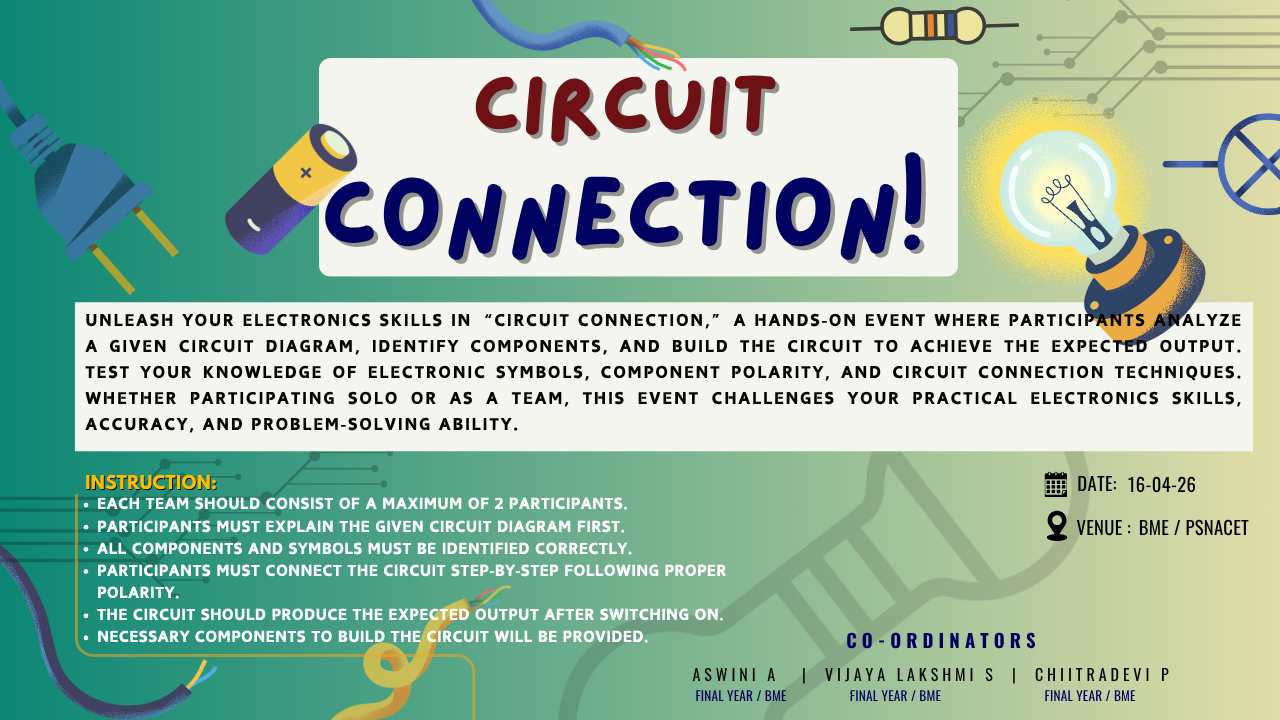
Analyze, identify, and build circuits — test your electronics skills and problem-solving ability.
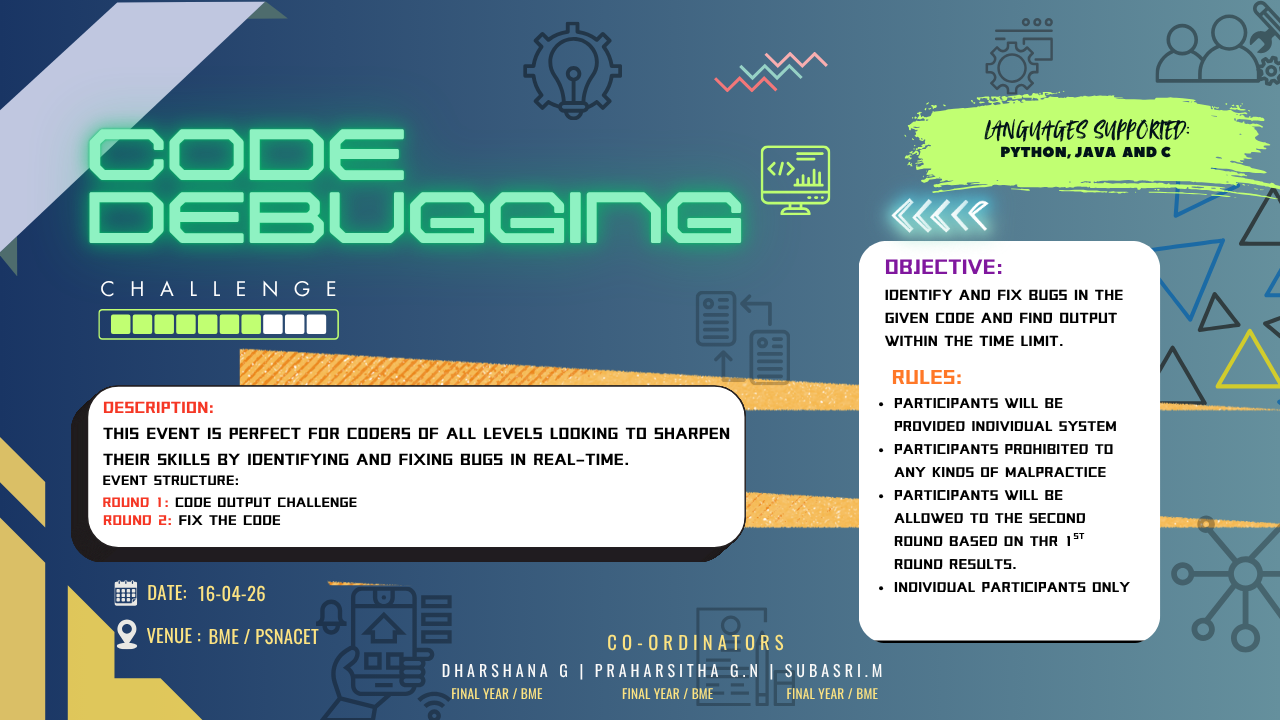
Identify and fix bugs in Python, Java & C — two rounds of real-time debugging challenges.
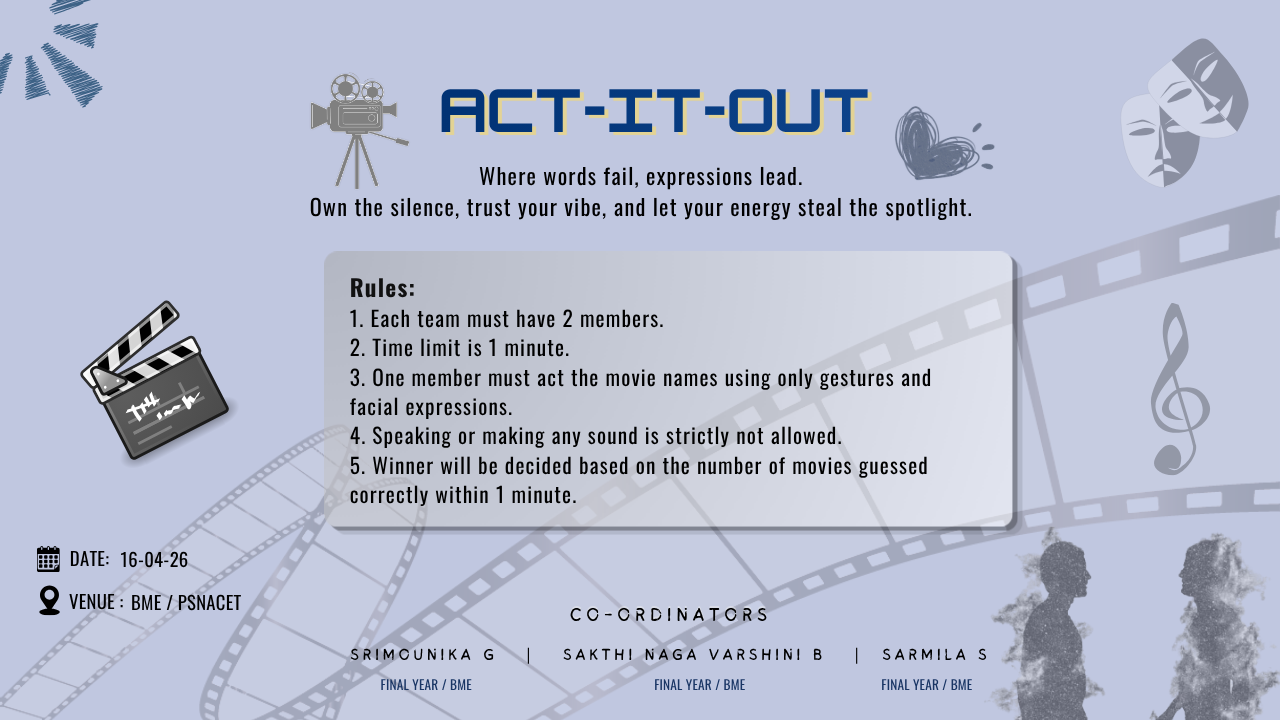
Charades-style fun — act movie names using only gestures, no speaking allowed! Teams of 2.
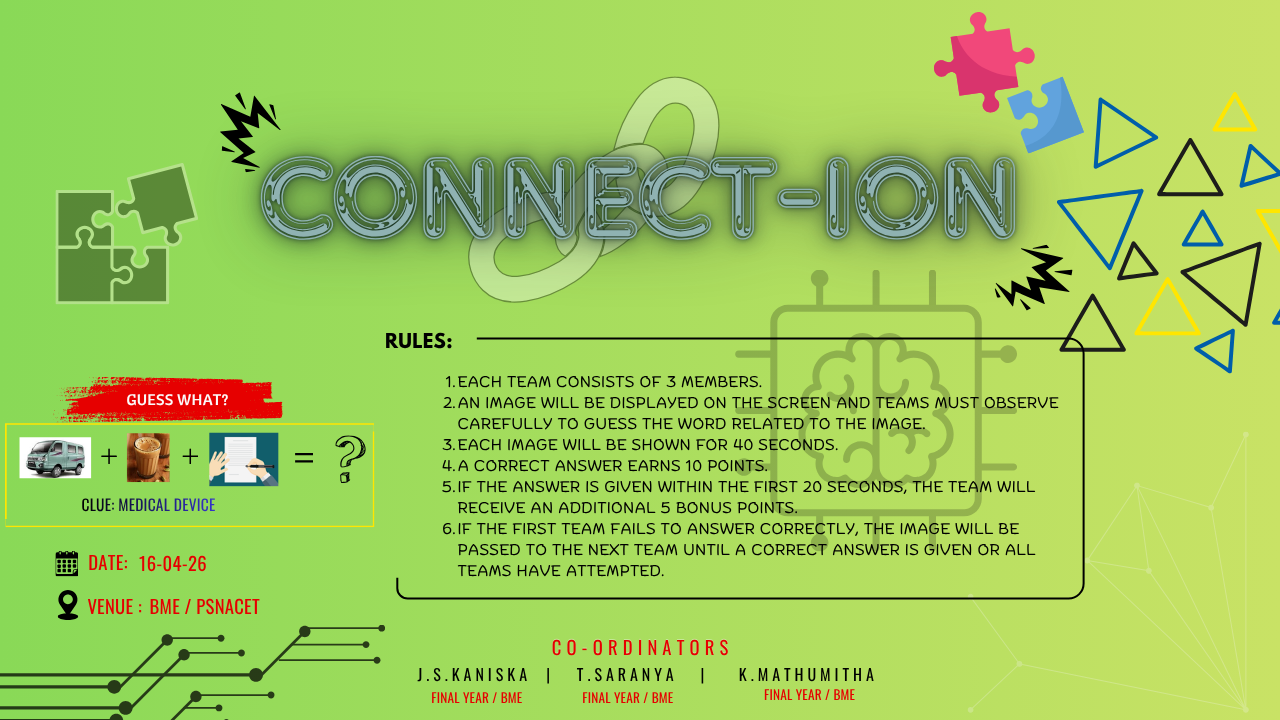
Guess the word from image clues — teams of 3, bonus points for fast answers within 20 seconds.
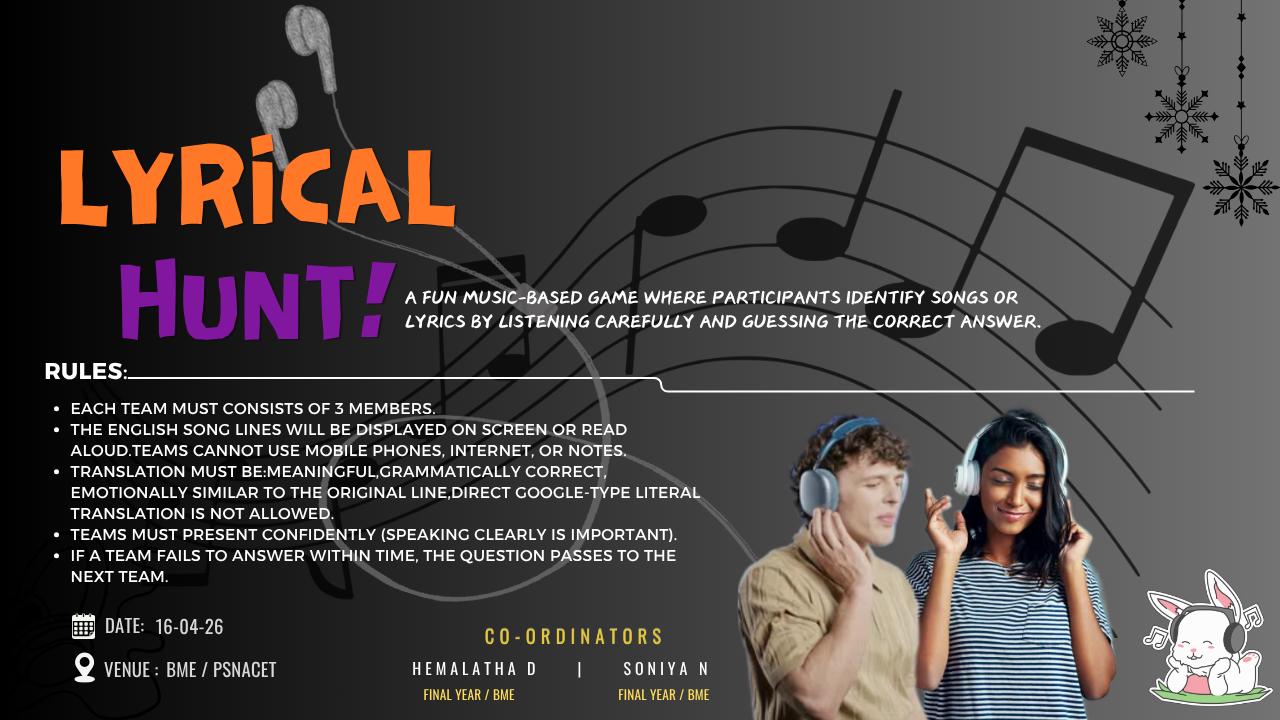
Identify songs and translate lyrics — a fun music-based game testing your ear and creativity.
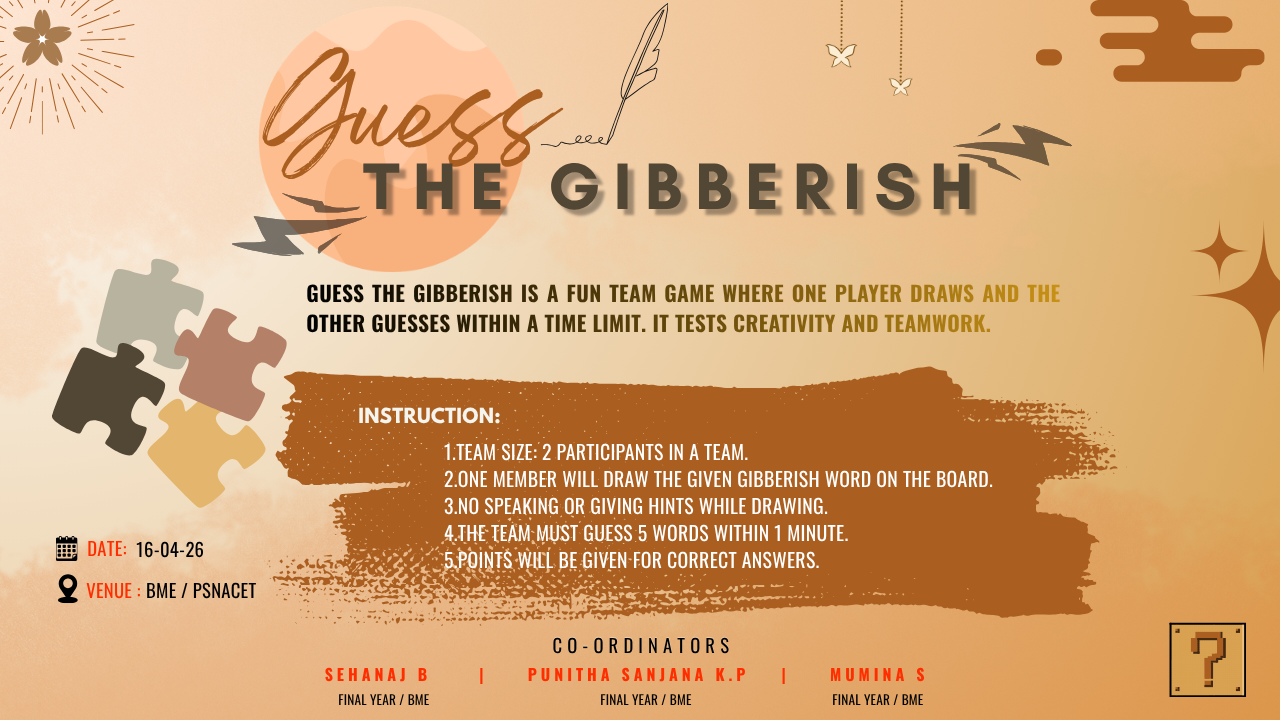
One draws, the other guesses — decode gibberish words through drawings in teams of 2.
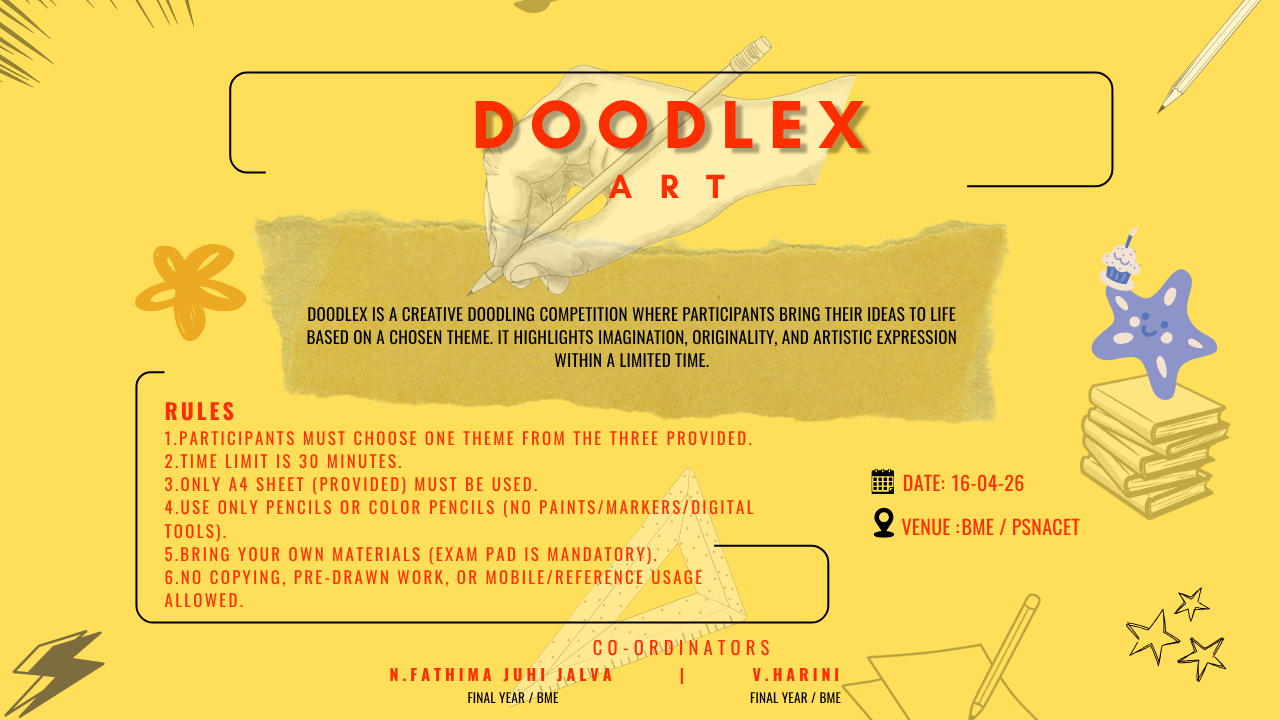
Creative doodling competition — bring ideas to life with pencils and color pencils in 30 minutes.
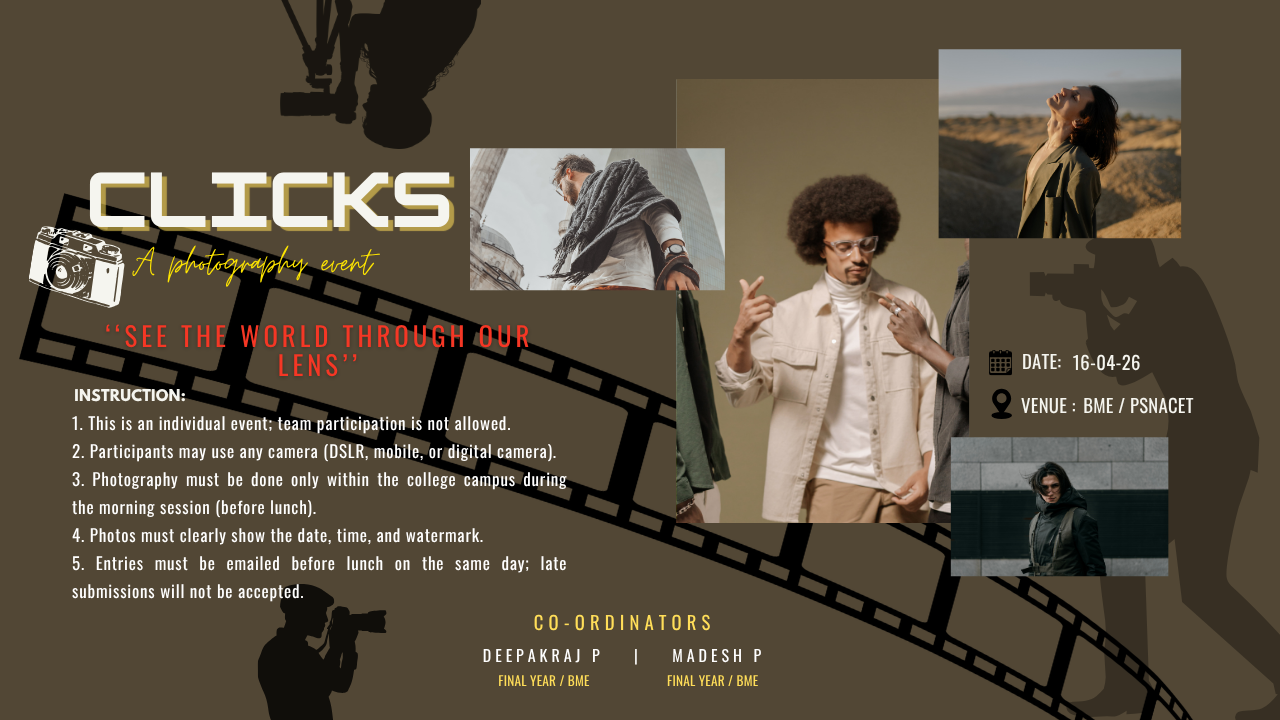
See the world through your lens — capture moments on campus with DSLR, mobile, or any camera.
Build embedded/circuit-based biomedical devices using standard sensor modules and microcontrollers.
Design a wearable device using a pulse oximeter sensor (MAX30100/MAX30102) that continuously monitors SpO2 and heart rate, displays real-time values on an OLED screen, and triggers an alert when readings fall below safe thresholds.
Build a surface EMG acquisition system using electrodes and a signal conditioning circuit that detects at least 2 distinct muscle gestures and maps them to control actions (e.g., cursor movement, LED trigger, or wheelchair direction).
Develop a device that uses an IR drop sensor to count IV drip flow rate in real time, calculate volume infused, and send an alert (buzzer/LED) when the drip runs out or deviates from the target rate.
Create a 2-lead ECG acquisition circuit using instrumentation amplifiers and an Arduino/ESP32 that captures and displays a real-time ECG waveform on a serial plotter or small LCD screen.
Build a wristband/waist-worn device using an MPU6050 accelerometer that detects sudden falls, distinguishes them from normal activities, and sends an SMS/buzzer alert to a caregiver.
Build ML/AI-powered biomedical applications using publicly available datasets and pre-trained models.
Develop a mobile/web app that takes a photo of a skin lesion and classifies it as normal, benign, or potentially malignant using a pre-trained CNN (MobileNet/ResNet). Must show confidence score and a brief recommendation.
Using a publicly available EEG dataset (e.g., PhysioNet), build an ML pipeline that classifies mental states (focus vs. fatigue vs. relaxed) from band-power features and visualizes results in a dashboard.
Build a system that takes real-time bed occupancy input and uses a scheduling/optimization algorithm to suggest optimal bed allocation across departments, with a visual dashboard showing availability and patient priority.
Create a mobile app where patients log their prescriptions; the app sends smart reminders, tracks adherence streaks, and generates a weekly compliance report that can be shared with a doctor.
Build a web app that accepts a fundus image upload and uses a pre-trained deep learning model to flag signs of diabetic retinopathy (No DR / Mild / Moderate), helping in early screening at low cost.
Build a low-tech adherence app with SMS reminders, local health worker check-in logging, and incentive tracking to help TB patients complete their full course of treatment. Target: improve cure rates from 82% to 95%+.
Build a blood availability portal where blood banks can update stock (blood group + units available) and users can search by city or pincode. Bonus: integrate WhatsApp API to send alerts when a requested blood group becomes available nearby.
Co-ordinators: Mathubharathi A & Kishor Bhuvaneswaran M
April 16, 2026 — a full day of innovation & fun
Secure your spot — limited seats available
BME Department / SRL Auditorium
PSNA College of Engineering & Technology, Dindigul
B. Balaprakash — 76959 54808
M. Geetha — 97918 82571
Dolly Angelin A. — 93451 93616
Registration Fee: ₹250/-
Certificate for all participants • Food will be provided
Open for all Engineering Departments
Follow us: @medxperia_2k26